
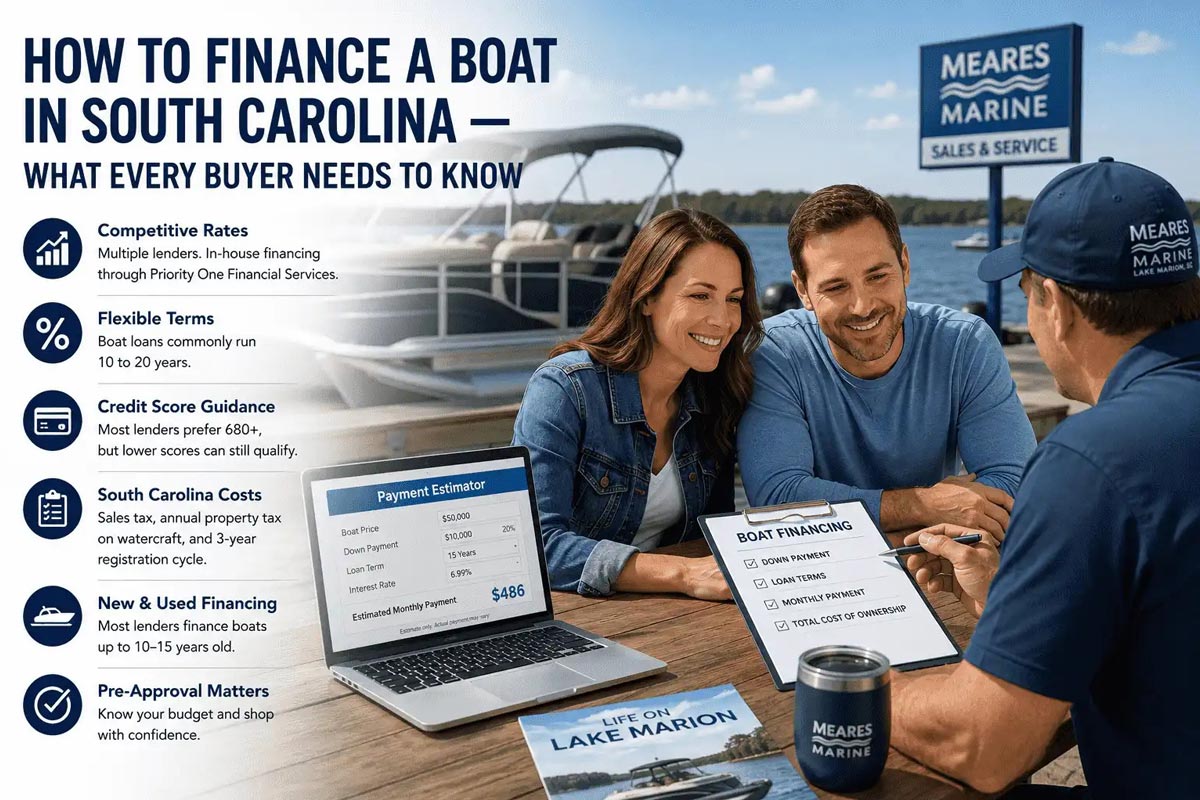
Most people buying a boat aren’t paying cash. That’s not a problem. Boat financing is straightforward once you understand how it works — and what South Carolina adds on top of the purchase price that most buyers don’t see coming.
At Meares Marine, in-house financing runs through Priority One Financial Services — the nation’s oldest and largest marine financing company. Buyers apply online or in the dealership. Multiple lenders, competitive rates. But before you get to the application, there’s some groundwork worth doing.
Key Takeaways
- Most marine lenders work best with credit scores above 680 — but lower scores can still qualify with a larger down payment
- Standard down payment on a boat loaan is 10 to 20 percent
- Boat loans commonly run 10 to 20 years — longer terms mean lower payments but more interest overall
- South Carolina adds sales tax, annual property tax on watercraft, and a three-year registration cycle — plan for these before you fall in love with a model
- Most lenders won’t finance boats older than 10 to 15 years
- Pre-approval before you shop puts you in a stronger position at the dealership
What Is the Best Way to Finance a Boat?
Get pre-approved before you walk into a dealership — Meares Marine’s boat financing runs through a network of marine lenders, not a single bank. That’s it. That’s the answer.
Pre-approval tells you exactly what you can spend before you start looking at inventory. It protects you from falling in love with a $65,000 tritoon when your budget realistically supports $45,000. And it speeds up the purchase process significantly once you’ve found the right boat.
At Meares Marine, the financing process runs through Priority One Financial Services — a network of marine lenders, not a single bank. That matters because different lenders have different appetites for credit profiles, loan terms, and boat ages. A network gives you more options than walking into one bank and taking whatever rate they offer.
Use the payment estimator at mearesmarine.com before you apply. Plug in the boat price, down payment, and loan term and get a realistic monthly number. Do that before you fall in love with a specific model.
What Credit Score Do You Need to Finance a Boat?
Most marine lenders work best with scores above 680. That’s not a hard cutoff — it’s where rates get competitive.
Below 680 doesn’t automatically disqualify you. A larger down payment offsets credit risk for most lenders. So if your score is 620 and you can put 25 to 30 percent down, you’re in a different conversation than someone with the same score putting nothing down.
Above 720 and you’re in the best rate tier most lenders offer. The difference between a 680 and a 740 score on a $50,000 boat loan over 15 years can be several thousand dollars in total interest. Worth knowing before you apply.
And credit scores aren’t fixed. If you’re six months out from a purchase, it’s worth checking your report for errors at AnnualCreditReport.com, paying down revolving balances, and avoiding new credit applications. Small moves that can shift your score 20 to 40 points before you apply for anything.
How Much Should You Put Down?
Ten to twenty percent is standard on a boat loan. On a $50,000 pontoon that’s $5,000 to $10,000 upfront.
A larger down payment does three things. It lowers your monthly payment. It may improve your interest rate. And it reduces the risk of being underwater on the loan — meaning you owe more than the boat is worth — which matters if you ever want to sell or trade up.
Don’t drain your emergency fund to hit a down payment number. Boats have maintenance costs. Winterization, annual service, dockside storage, fuel — those add up. Going into ownership cash-poor creates problems fast. Put down what you can reasonably afford and keep a cushion.
How Long Are Boat Loan Terms?
Boat loans commonly run 10 to 20 years. That’s longer than most people expect.
Shorter terms — 10 to 12 years — mean higher monthly payments but less interest paid overall. Longer terms — 15 to 20 years — lower the monthly payment but cost significantly more over the life of the loan.
A $50,000 boat at 7% interest over 10 years runs about $580 per month. The same loan over 20 years drops to around $390 per month — but you pay roughly $18,000 more in total interest.
Neither term is wrong. It depends on cash flow and how long you plan to keep the boat. If you’re buying a new Crest pontoon and plan to keep it for 15 years, a longer term makes sense. If you’re buying used and expect to upgrade in five years, a shorter term keeps you from being upside down.
What Is the Oldest Boat You Can Finance?
Most lenders cap financing at boats 10 to 15 years old. Some go to 20 years for well-maintained models with low hours. But the older the boat, the fewer lenders will touch it — and the ones that do charge higher rates.
If you’re buying a used boat that’s pushing that age limit, cash or a personal loan may be more practical than a marine-specific loan. Meares Marine’s lending partners can tell you quickly where a specific boat lands.
What South Carolina Adds That Most Buyers Miss
This is where first-time buyers get surprised. The purchase price isn’t the full cost.
Sales tax. South Carolina charges sales tax on boat purchases. Factor it into your budget before you start shopping — not after you’ve agreed on a price.
Annual property tax on watercraft. If your boat is in South Carolina more than 180 days a year, the state taxes it as personal property. The rate varies by county. In Clarendon County, it’s worth getting a specific number before you buy — it’s an annual cost that doesn’t go away.
Boat registration. South Carolina registration runs on a three-year cycle. For current fees and requirements, visit the South Carolina Department of Natural Resources. First-time buyers sometimes forget to account for it.
Insurance. Lenders require proof of insurance before they fund a loan. Budget for it. Marine insurance on a $50,000 pontoon typically runs $300 to $600 per year depending on coverage, your boating history, and where the boat is stored.
Add those up before you commit to a monthly payment. The boat payment is one line item. Total cost of ownership is a different number.
New vs. Used — How Financing Differs
New boats are easier to finance. Lenders love them — clear value, manufacturer warranty, no history to worry about. Rates are typically better on new inventory.
Used boats are financeable but come with more variables. Age restrictions apply. Lenders want an appraisal or book value check on older boats. And if the boat has deferred maintenance, that affects value — which affects how much a lender will approve.
Before financing any used boat, have a factory-trained technician inspect it. At Meares Marine, that inspection covers engine hours, lower unit condition, electrical system, and hull integrity. A $200 inspection can save you from a $5,000 problem you didn’t know you were buying.
How to Apply at Meares Marine
Straightforward process. Apply online at mearesmarine.com or in the dealership.
What to bring:
- Government-issued ID
- Proof of income — pay stubs or two years of tax returns if self-employed
- Proof of insurance before funding
Priority One Financial Services works with a network of lenders to find the best fit for your credit profile and the boat you’re buying. Approvals typically come back within one to two business days. The full purchase process from first visit to driving away runs three to five business days for new boats. Used boats can move faster.
Frequently Asked Questions
What is the best way to finance a boat?
Get pre-approved before you shop. Use a marine-specific lender network — not just your personal bank — to compare rates across multiple lenders. Meares Marine’s financing runs through Priority One Financial Services, which accesses a full network of marine lenders in one application.
What credit score is needed to finance a boat?
Most marine lenders work best above 680. Below that can still qualify with a larger down payment. Above 720 gets you into the best rate tiers.
What credit score is needed for boat financing specifically?
Same answer — 680 is the practical floor for competitive rates. But the full picture includes down payment, loan term, boat age, and income. A lower score with strong compensating factors still gets approved regularly.
What is typical boat financing?
Ten to twenty percent down, loan terms of 10 to 20 years, and rates that vary based on credit score, loan term, and boat age. Marine loans work similarly to auto loans but with longer terms and different lender requirements.
What is the oldest boat you can finance?
Most lenders cap at 10 to 15 years. Some go to 20 for well-maintained boats with documented service history. Older than that, cash or a personal loan is usually more practical.
Do I need insurance before my loan is funded?
Yes. Every marine lender requires proof of insurance before releasing funds. Get a quote before you apply so there’s no delay at closing.
Ready to Talk Numbers?
Come see what’s at the dock at Meares Marine — and bring your questions about financing. The boats are on Lake Marion. The boat financing is in-house. And the payment estimator at mearesmarine.com gives you a realistic number before you ever walk through the door.
Meares Marine
2058 Lake Shore Drive, Manning, SC 29102
(803) 478-2527
info@mearesmarine.com
Sales & Service: Mon–Fri 9am–5:30pm | Sat 9am–1pm